
Recent Post


Ultimate Guide Cloud Modern
15 October 2024
IT Consulting Can Boost
15 October 2024
The "GPS Moment" for IT Operations: Unpacking ServiceNow’s Australia ITOM Release
Think about the last time you were genuinely, completely lost while driving. If you’re like most modern professionals, it hasn't happened in years. Why? Not because our sense of direction improved, but because GPS technology became so seamless, reliable, and accessible that getting lost became nearly impossible.
In IT Operations, we've long been searching for that same "GPS moment", the point where navigating complex infrastructure incidents stops being a chaotic guessing game and becomes an automated, effortless journey.
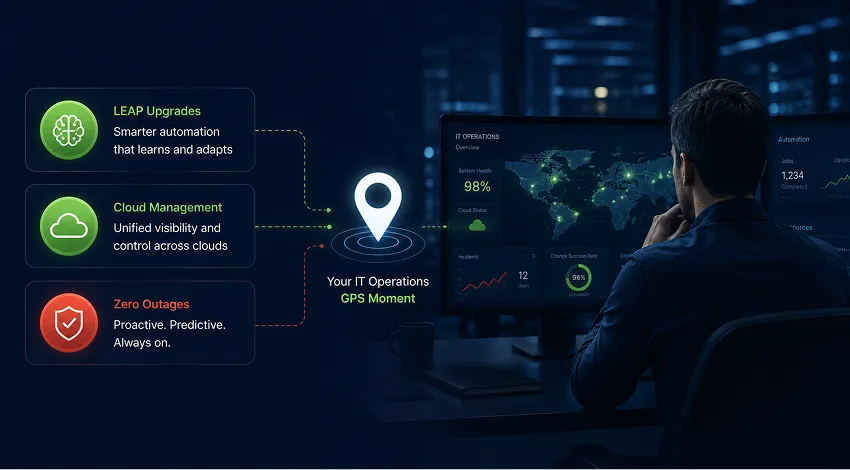
With the ServiceNow Australia ITOM release, that moment has arrived. Specifically focusing on major upgrades to LEAP (Learning-Enhanced Automation Platform) and cloud management capabilities, this release eliminates operational friction and shifts organisations closer to the ultimate goal: zero service outages.
Here is everything IT operations leaders and enterprises need to know about this game-changing update.
Democratic AI Access: Multi-LLM Support at No Extra Cost
Previously, unlocking the full predictive power of LEAP required specific licensing and a high level of AI maturity. The Australia release tears completely down these barriers.
ServiceNow has democratised its AI capabilities by opening LEAP to all customers. Enterprises can now choose the Large Language Model (LLM) that best aligns with their security and compliance environment, whether that is ServiceNow’s native model, OpenAI, Gemini, or Anthropic, all at no additional cost.
Beyond Internal Data: Smarter Resolutions with External Web Search
Every operations team dreads the "long tail" of incidents, rare, unprecedented system failures, where internal documentation or historical work notes are completely blank.
To solve this, LEAP now integrates external web search (via Gemini or Perplexity) alongside internal Knowledge Base (KB) articles. When internal signals are weak, the AI safely reaches outward to surface exact, documented resolution steps. The result? Fewer escalations to subject matter experts and dramatically reduced Mean Time to Resolution (MTTR).
Granular Target Triage: Refined Opportunity Grouping
A common pain point in incident management is the "mega-cluster." For example, a single underlying root cause might trigger 300 overlapping incidents. Historically, an automation engine would generate a blanket, generic resolution for the entire cluster, which rarely works for every individual device or subsystem involved.
The Australia release introduces Refined Opportunity Grouping. LEAP now automatically parses massive incident clusters into highly focused sub-groups based on shared sub-categories. Instead of generic guidance, engineers get hyper-specific, actionable steps they can apply immediately.
Continuous Institutional Learning: Direct KB Generation & SOW Integration
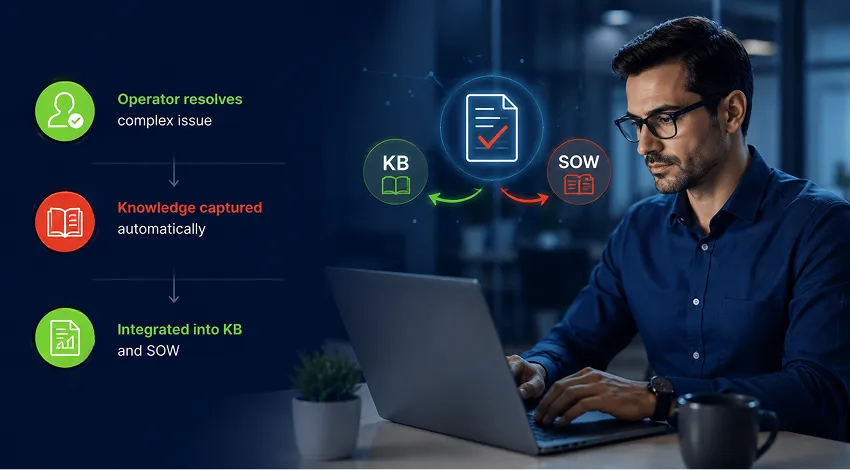
When an operator successfully resolves a complex issue using LEAP, that knowledge shouldn't vanish when the ticket closes.
- Instant KB Generation: Operators can now promote successful LEAP resolution steps directly into the company’s Knowledge Base with a single click.
- Proactive SOW Surfacing: These newly created articles are integrated directly into the Service Operations Workspace (SOW). The next time a similar incident occurs, the resolution steps automatically pop up on the operator’s dashboard before they even think to search for it.
Unified Cloud Governance: Blending Inventory with Spend
For businesses leveraging Cloud Accelerate and Cloud Governance Suite, managing cloud footprint and cloud spend used to require jumping between disconnected dashboards.
If you hold a Cloud Cost Management (CCM) entitlement, this release brings integrated spend visibility directly into the Cloud Workspace. Account-level spend trends, monthly budget tracking, and variances now sit natively alongside your technical inventory, cloud ownership, and security data. Operations leaders can finally make holistic governance decisions with financial clarity built right in.
The Ripton Solutions Perspective: Accelerating Your Flywheel
At Ripton Solutions, we see the ServiceNow Australia ITOM release as a fundamental shift from reactive troubleshooting to self-healing IT environments. Just like a GPS gets smarter the more people use it, LEAP uses compound learning to make your entire IT ecosystem sharper with every closed ticket.
By eliminating AI licensing friction, expanding search horizons, and marrying cloud infrastructure with cost management, ServiceNow is ensuring that nothing stands in the way of your operational efficiency.
Ready to upgrade your ITOM landscape and activate self-healing operations? Contact our ServiceNow experts at Ripton Solutions today to map out your migration strategy.