
Recent Post


Ultimate Guide Cloud Modern
15 October 2024
IT Consulting Can Boost
15 October 2024
How Autonomous CRM Unites Workflows, Data, and Generative AI to Resolve the Enterprise Completion Problem
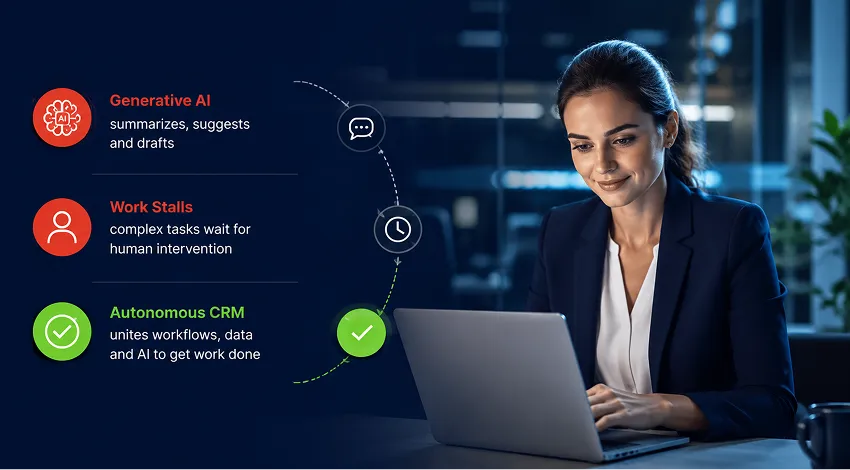
ServiceNow CRM Company Story May 5, 2026 Las Vegas, NV Across modern sales floors, customer contact centers, and field fulfillment operations, a familiar and frustrating operational limitation continues to restrict corporate digital transformation initiatives. Generative artificial intelligence utilities can quickly summarize a customer case, suggest a plausible next step, or draft a polite email response. However, when it comes to resolving the actual underlying issue,such as generating an accurate price quote, modifying an active order, or fulfilling a complex logistical dispatch,traditional tools fall short. The actual operational work stalls, waiting for a human employee to manually log into disconnected systems to finish the task.
This functional gap exists because legacy customer relationship management (CRM) architectures were fundamentally designed as passive systems of record,glorified databases meant for manually logging sales activities and tracking customer touchpoints after they occurred. Recent investments in generative AI have merely layered a conversational chatbot on top of these same fragmented foundations. While these bots can engage in natural conversations, they remain structurally decoupled from the deep backend workflows, cross-functional data schemas, and transactional approval chains required to execute actual enterprise work. To address this deficiency, ServiceNow has introduced Autonomous CRM, a strategy that shifts the role of customer management software from merely tracking business transactions to actively executing them.
Autonomous Service: Delivering End-to-End Resolution Across Channels
The transition to an autonomous customer service model introduces dedicated AI specialists engineered to handle customer inquiries across any communication channel, shifting the platform focus away from simple case tracking toward automated, end-to-end resolution. Central to this architecture is the newly introduced CRM Case Management AI Specialist, a digital worker capable of qualifying, processing, and closing out service cases across their entire lifecycle. Operating natively across voice, chat, and digital channels, this framework automates self-service interactions, seamlessly managing backend system updates even when human managers are required within the approval loop.
To illustrate this capability in practice, consider a scenario where a customer contacts an enterprise to alter an order that has already been shipped. Instead of generating an isolated support ticket that sits in a manual queue, an AI specialist programmatically verifies the fulfillment status, confirms the account’s financial standing, redirects the physical shipment with the carrier, updates the internal billing records, alerts the distribution warehouse, and logs an explainable audit trail. This entire sequence executes before the initial customer interaction concludes, completely eliminating manual handoffs and multi-system toggling. On a macro scale, the ServiceNow platform is already managing substantial transaction volumes via these agentic frameworks, processing more than 100 million customer cases and orchestrating over 16 million orders every month.
Optimizing Field Operations and Real-Time Parts Allocation
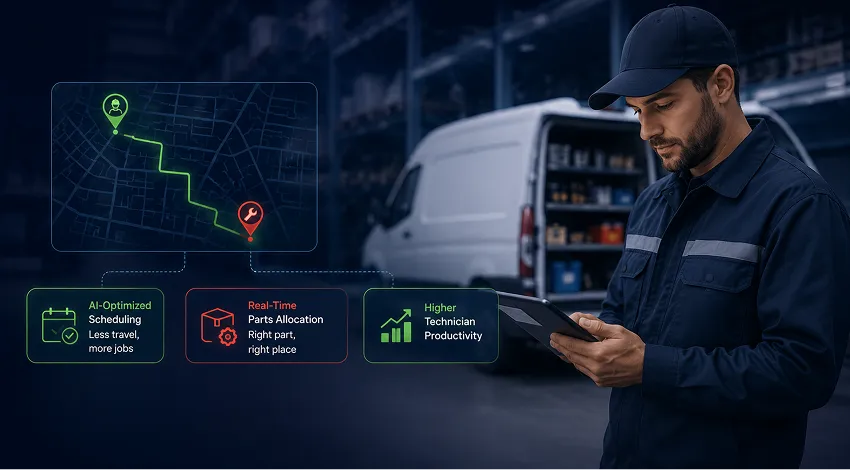
The capabilities of Autonomous CRM extend directly past the digital contact center into the physical environment of field service delivery, where the platform executes approximately 11 million work order tasks per month. New AI-driven field innovations prioritize technician efficiency from the exact moment an operational schedule is compiled to the point of on-site job completion. By embedding AI-powered schedule optimization directly into field workflows, the platform eliminates transit friction and ensures that specialized field technicians are dynamically routed to the locations where their expertise is required most.
To prevent the common operational delay of technicians arriving at a job site without the required diagnostic components, the platform introduces the Part Manager AI Agent. This agent programmatically coordinates parts availability, transit logistics, and inventory tracking before a field technician ever leaves the local dispatch depot. Once on-site repairs or installations are completed, technicians can close out their assigned service records via ServiceNow Lens. This technology leverages computer vision to automatically transform a simple smartphone photo of the finished mechanical work into a fully structured, populated work record, resulting in fewer return truck rolls, accelerated time-to-resolution, and a workforce focused on critical field execution rather than manual documentation.
Autonomous Sales: Eliminating Administrative Friction to Prioritize Relationships
In the sales domain, administrative overhead routinely consumes hours of a seller's productive week, keeping teams tied to spreadsheet management rather than active client engagement. To automate these intensive administrative cycles, the platform leverages its Configure, Price, Quote (CPQ) solution,now the fastest-growing product in the ServiceNow CRM portfolio, processing over 7 million transactions on a monthly basis. The system features agentic quoting capabilities that scan real-time chat logs and voice call transcripts to automatically draft accurate customer quotes while dynamically surfacing intelligent, context-driven product recommendations to maximize deal sizing.
Sellers can also leverage interactive, conversational selling interfaces powered by native integrations with ServiceNow Otto, OpenAI, and Anthropic. This design allows account executives to update opportunity pipelines, review deal progression states, and log meeting notes via a single unified chat interface. To further align top-of-funnel customer acquisition with deep backend execution, an extended original equipment manufacturer (OEM) partnership with Tenon integrates native marketing automation directly into the ServiceNow environment. By connecting lead generation mechanisms with live sales pipelines in a single operating platform, organizations can ensure faster lead response times and achieve higher conversion rates.
Industry Workflows: Embedding Domain Context into the AI Fabric
For years, customer-facing corporate teams have been forced to rely on generic software built for a broad market, which frequently means the tools lack the specific contextual capabilities required to handle nuanced, regulated workflows. Autonomous CRM for Industries addresses this misalignment by embedding the specific regulations, data models, and operational realities of distinct vertical markets directly into the AI fabric, managed through a unified data architecture and supervised by a single AI Control Tower:
- Technology Providers: AI agents manage structured product adoption planning and comprehensive renewal preparations, freeing customer success managers to focus entirely on direct client relationship cultivation.
- Government and Public Sector: Document Classification AI injects automated structure and processing speed into intensive regulatory and investigative workloads.
- Financial Services: An agentic contact center framework ensures that banking and insurance clients achieve immediate case resolution without getting passed between separate departmental silos.
- Telecommunications: Purpose-built Customer 360 workspaces supply customer service agents with complete, real-time context before a support interaction begins.
- Manufacturing: Dedicated AI frameworks cover the entirety of commercial operations, including the automated identification of quality anomalies, warranty fraud mitigation, order exception processing, and complex multi-tier quoting.
- Healthcare: Operational coordination is unified across care teams, biomedical engineering, facilities management, environmental services, and IT on an AI-native platform embedded directly within the electronic medical record (EMR).
- Retail: Corporate headquarters construct structured, recurring task plans using guided playbooks, which store associates receive and execute via a mobile application directly on the retail floor.
What Should Organisations Do Now?
To transform customer operations from static tracking models into fully automated, autonomous execution frameworks, enterprise technology leaders should adopt the following actionable approaches:
- Audit Legacy CRM Handoff Points: Identify and document all operational bottlenecks where current front-office chatbots or CRM tools stall and require manual employee intervention to complete a backend transaction.
- Deploy CRM Case Management Specialists: Implement the CRM Case Management AI Specialist across digital interaction channels to automate multi-step processes like order modifications and account updates without manual ticket generation.
- Optimize Field Logistics via Agentic Tools: Integrate the Part Manager AI Agent and AI-powered schedule optimization into field service dispatch workflows to reduce transit times and ensure parts availability.
- Leverage Computer Vision on the Service Floor: Equip field teams with ServiceNow Lens to automate the closure of field service records, replacing manual form entry with photo-based asset registration.
- Consolidate Sales Workflows onto a Single Platform:Transition commercial operations away from separate quoting tools by adopting agentic CPQ solutions to automate pricing configurations from active conversation transcripts.
Conclusion
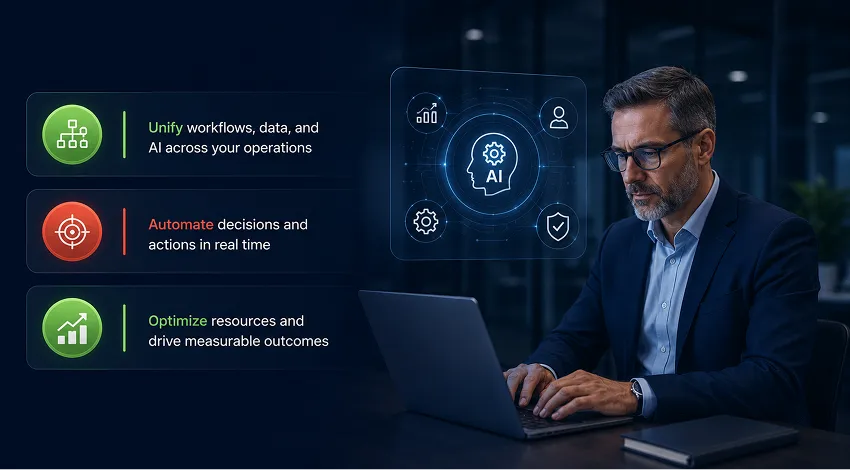
The deployment of ServiceNow Autonomous CRM marks a clear departure from the era of passive customer tracking, replacing static data logging with an active, self-executing workflow infrastructure. By anchoring generative AI components within a single, compliant platform architecture that combines real-time data access with deterministic workflow execution, modern corporations can successfully resolve the industry's systemic AI completion problem. As organizations scale these automated frameworks across specialized industry verticals, the ability to execute transactions autonomously will separate high-performing, agile enterprises from those still bogged down by legacy administrative friction.